
When sport stops: the identity crisis athletes don't talk about
This year, I had to cancel my half marathon. The year before, my Hyrox. Every time, it's the same: I reach the end of my rope (this is how we say it, right?). I'm completely sad and not being able to train makes me irritable and bitter!!
For a competitive athlete, sport isn't just an activity. It's an identity. When it stops (injury, pregnancy, end of a career), it's not just the body that takes the hit, it's the answer to the question: who am I?
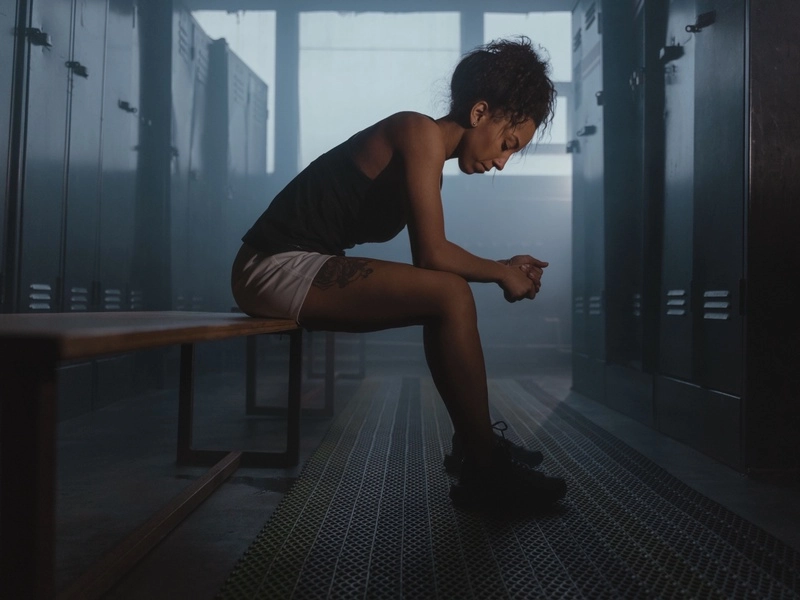
Sport as identity
A competitive athlete doesn't do sport. They are an athlete. That distinction matters!
Their schedule, relationships, goals, the reason they get up in the morning,... EVERYTHING organizes around training and competition. Sport structures time, gives meaning to effort, and provides community.
When all of that stops, even temporarily, a part of the identity disappears with it. It's not a lost hobby, it's a piece of self.
Sports psychology has a term for this: identity enmeshment. When personal identity and athletic identity become so fused that it's impossible to separate one from the other.
What happens in the brain
Regular competitive sport changes the brain's chemistry. Intense physical effort releases dopamine, serotonin, endorphins. These molecules regulate mood, stress, and the sense of competence.
When training stops abruptly, those levels drop. This isn't a metaphor, it's a real neurochemical reaction, similar to what's observed in certain withdrawal states.
That's why a forced stop from sport often produces: irritability, sleep disruption, a sense of emptiness, difficulty focusing. The body isn't just missing movement. The brain is missing its usual regulators!
Read more
Article: "Athlete burnout: when training too hard exhausts your brain first"
Two profiles, one reality
Sudden injury
This is the stop nobody planned for. A knee, a shoulder, a stress fracture, a tendon... Training disappears overnight, competitions get canceled...
What athletes go through: anger first. Frustration then, or at the same time. Then a void that's hard to name. And, finally often a deeper question: if I'm not performing, who am I?
The physical injury is visible, treated, managed. The identity injury stays invisible.
And many injured athletes rush their return; not just because the body is ready, but because they can't stand the absence.
Maternity
This is a particular kind of stop, and one that's rarely talked about in sports culture. A female athlete who gives birth doesn't just lose physical performance temporarily. She goes through a total identity transformation, at the exact same moment she's building a new one.
Athlete and mother. Two identities that coexist, and sometimes collide. The body changes. Goals change. The relationship to time changes.
"I don't recognize myself anymore."
"I feel like I've lost something I'll never get back."
"I feel guilty for wanting my level back."
This isn't a lack of gratitude. It's a real identity transition, one that deserves to be named and supported.
The link with expat identity crisis
What athletes go through when sport stops looks a lot like what expats go through on return.
Haha, I'm mentioning this because, in case you didn't know, I also specialize in expatriation! In fact, I myself lived in the United States for a few years.
In both cases, an identity built around a specific context disappears, and a new one has to be built.
The same mechanisms are at work: loss of familiar mirrors, absence of landmarks, the feeling of being between two worlds without fully belonging to either.
Read more
Article: "Expat identity: who am I when I change countries?" (the same process of identity reconstruction, in a different context)
What actually helps
- The first thing: naming what's happening. Stopping sport isn't just a physical constraint, it's an identity transition. Recognizing it as such already changes something.
- Don't wait for it to pass on its own. Time helps, but time alone doesn't rebuild an identity. It takes active work to understand who you are outside of sport.
- Stop defining yourself purely through performance! Easier said than done when sport has been at the center of everything for years... But that's the real work.
- Find spaces to actually talk about it. People around you often want to reassure: "you'll come back stronger." That's not always what an athlete needs. Sometimes they need someone to hear how hard this is, without rushing to fix it.
What's next?
If this article helped you gain a bit more clarity, you can take the reflection further.
Book your discovery call: free and no commitment
If you have a question, a hesitation or need clarification, I will answer with clarity and transparency.
Contact me directly
If you have a question, a hesitation or need clarification, I will answer with clarity and transparency.