
What bullying really does to a child / teenager
I was bullied for several years. I know this subject from the inside.
I wish, back then, I had had someone who had been through it too. Someone who could say: I know what this is, and you can get through it.
That is one of the reasons I work with bullied young people today, and with their parents.
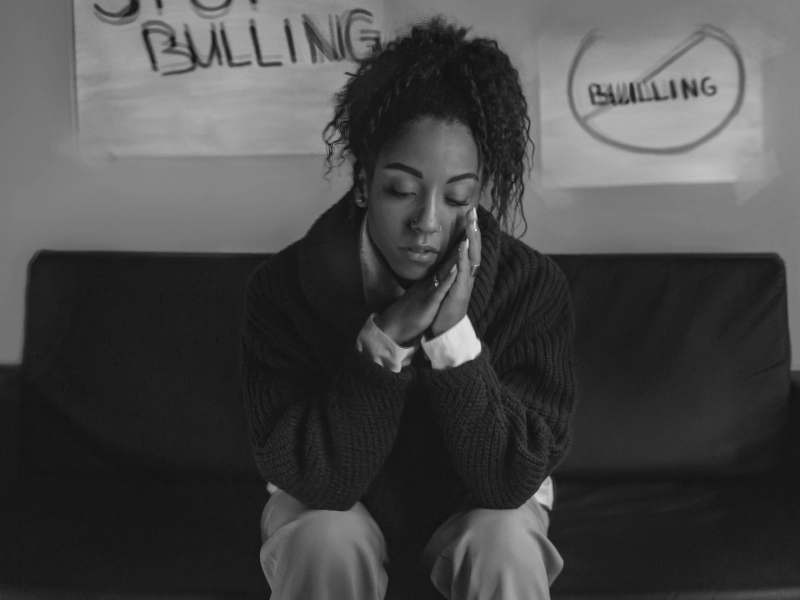
There is not just one profile
When we talk about bullying, we tend to picture the same image. A child who breaks down, withdraws, goes silent.
But there is also the other profile. The one who fights back, who overperforms, who never stops pushing. The one nobody worries about, because they seem fine.
Both are hurting. Both deserve support. Both can heal.
There is no right way to respond to bullying. There is just your way, and what it is really costing you.
What it does to self-esteem
Bullying works through repetition. It is not an isolated incident. It is a message that keeps coming back: you are not like the others, you do not deserve your place here. With enough repetition, the brain starts to believe it. Not because the child is weak, but because that is how learning works: what is repeated becomes a conviction.
What I see in sessions: young people who systematically doubt themselves. Who minimize their achievements, who expect rejection before they have even tried... This is not a passing lack of confidence. It is a deep belief, built up over months.
Damaged self-esteem cannot be fixed with compliments. It rebuilds through experience, gradually.
What it does to the body
Bullying is chronic stress. Even after it stops, the body stays on alert.
Sleep problems, recurring stomach aches, headachesn, eczema, unexplained fatigue, constant hypervigilance... Monitoring others’ reactions, anticipating danger, never quite relaxing.
The body carries what words have not yet said.
These symptoms are not invented. They are the normal response of an organism that has learned its environment is dangerous, and keeps protecting itself even afterward.
Read more
Article: “Stress signals: what does your body say when you ignore your emotions?” ; the physical manifestations of prolonged stress.
The effects nobody sees right away
Some effects of bullying are visible. Others take time to surface, or stay hidden because the child does not make the connection themselves.
- Distrust. When you have been hurt by peers, you learn to protect yourself. You anticipate rejection before it arrives. You avoid showing vulnerability. That excessive caution can last for years.
- Minimization. Many bullied young people minimize what they went through. "It wasn't that bad." "I'm probably exaggerating." This is not resilience. It is often a way of surviving something too heavy to look at directly.
- Difficulty trusting. Not just others, but yourself. Your own judgment, your own perceptions, your own worth. Bullying creates doubt where there should be certainty.
- Traces into adulthood. I work with adults who still carry the effects of bullying from ten, fifteen, twenty years ago. Because no one named what they went through, or helped them move through it.
What happens in relationships afterward
Some young people become quiet, self-effacing. They have learned that "standing out" = danger.
Others become very controlling in relationships, to make sure they are never in a vulnerable position again.
There is also the loneliness of not being understood. Parents are relieved it is over. Friends have moved on. But the child is still carrying something nobody around them sees...
Without support, the road is longer
Not every bullied young person needs professional support. Some get through it with time, a safe environment, and family backing.
But let's be honest, without support, the road is often longer and more exhausting. You move forward, but you carry a weight you could have put down earlier.
Therapy may be necessary, depending on the situation (that should not be minimized).
Coaching is not therapy. It does not treat deep trauma. What it does: create a space to name what happened, understand the effects, and gradually rebuild a more accurate sense of self.
I wish I had had that space when I needed it. It is what I try to offer today.
Read more
Article: “Coaching, therapy, consulting, HR: what are the differences and how do you choose the right support?”
Finally...
Bullying leaves marks. That is not a life sentence, but it is not something that disappears on its own either. Naming what happened, understanding the effects, having a space to work through them... That is what makes the difference.
If you are a young person reading this: you did not deserve it. And there is no right or wrong way you should have reacted. There is just what it cost you.
If you are a parent: your child is not exaggerating. And you do not have to navigate this alone.
What's next?
If this article helped you gain a bit more clarity, you can take the reflection further.
Book your discovery call: free and no commitment
If you have a question, a hesitation or need clarification, I will answer with clarity and transparency.
Contact me directly
If you have a question, a hesitation or need clarification, I will answer with clarity and transparency.